Rodale Institute is preparing the next generation of regenerative organic farmers.

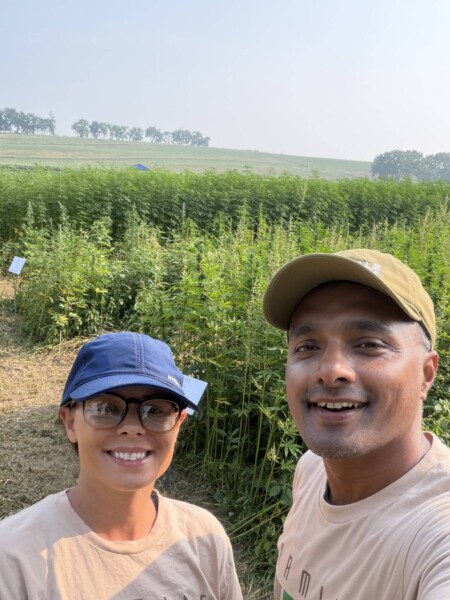
Shawn Cabalsi was building a successful career in the technology sector, but the 43-year-old felt unsatisfied by his accomplishments and disconnected from his purpose. “I got really interested in how to live more naturally, more ethically, more morally,” he says. “That brought me to farming.”
Just a few decades ago, farming was primarily a family business that was passed down from one generation to the next, along with the necessary land. The essential skills were learned on the job starting at an early age. Now the average age of American farmers is 58 years old, and most children from farm families choose less-demanding occupations. But a growing group of younger people, who come from different backgrounds and experiences, are opting for agriculture as a career.
Cabalsi joined the 2025 cohort of the Rodale Institute Farmer Training (RIFT) program, which teaches novice organic farmers about all aspects of establishing and maintaining an agricultural business. It’s a comprehensive, nine-month course that culminates in a capstone project: The students draft their own farm plans that they can use to set up their operations, apply for grants and other funding, and seek organic certification.
The nine RIFT participants for 2025 range in age from early twenties to early fifties, and they hail from locales across the United States. Most have little or no background in agriculture. They all, however, share a passion for building a brighter future for themselves and their families, their communities, and the planet through regenerative organic farming. Their stories about why they want to farm and what they plan to do inspire hope that they will succeed.
ORGANIC EDUCATOR: SHAWN CABALSI
Where he’s been. A Pennsylvania native, Cabalsi was working for tech companies when he began reading the works of agricultural philosophers Wendell Berry, E. F. Schumacher, and Masanobu Fukuoka. They introduced Cabalsi to ideas about ethical living and “their critiques of the modern American food system, the industrialization of our civilization, and the issues of environmental degradation,” he says. “Farming is a big step for me toward being more in harmony with nature.”

Where he’s heading. “I’ve helped found a nonprofit 501(c)(3) organic farm,” Cabalsi says. Located in Macungie, Pennsylvania, his 11-acre farm provides fresh produce to local people facing food insecurity. “I came to the RIFT program to learn how to do organic certification and grow with regenerative methods,” He adds. “We’re also planning to use the farm to educate community members about how to grow their own food and to connect with nature.”
RIFT students can now earn college credits at Northampton Community College in Bethlehem, Pennsylvania, for completing the Rodale Institute coursework. Cabalsi is using the credits toward earning a master of arts in regenerative design, an online graduate degree program offered through Prescott College. “This program explores how you design natural and social systems that are more regenerative versus extractive or wasteful,” he explains.
FAMILY FLORIST: DELANEY GEMMEL
Where she’s been. A flower shop in Allentown, Pennsylvania, has been in Gemmel’s family for several generations. Because of this background, she says, she began studying for a business degree (with an interest in small business) at Lehigh University. After graduation, she traveled to Ecuador, Spain, and Malawi, she became interested in the different cuisines and food production systems she had seen. “I was looking for what would be my passion in life,” she says, “and then I discovered that I love fresh food, farming, and working outside.”
Where she’s heading. “I want to keep that florist heritage alive within my family, so my goal is to start a small-scale flower farm that supplies my grandparents’ flower shop and my own [direct-to-consumer] market, which will be different than my grandparents’ shop,” Gemmel says. “I also want to use my business background to help other farmers with marketing or other needs. I want to make feel-good products and to support small businesses in my community.”
PLANET PROTECTOR: PAYTON WILKS

Where he’s been. Raised in Tipp City, Ohio, a Dayton suburb surrounded by cornfields, Wilks studied acting, anthropology, and French at Ohio University and then traveled for a few years, including a spell teaching English in France. When he moved back to the US, he pursued a certification in project management. While gathering skills in this field, he thought about what kinds of projects he wanted to work on. “I thought about what would have the biggest impact,” he explains. “For me, climate change is one of the most important issues that’s facing humanity.” Wilks explored opportunities in renewable energy, but they didn’t inspire him. “Then I started learning about regenerative organic agriculture and how we can use soil to sequester carbon and grow food for ourselves while also taking care of the planet,” he says. “That really excited me.”
Where he’s heading. “I would like to initially find farms that are doing diversified vegetable production, the kind of farming that I want to do,” Wilks says. “After working as a farm manager for a few years, I’ll be ready to start my own [operation]. I would consider going international—going back to France, potentially—but right now I’m kind of sticking with the Midwest or here in Pennsylvania.”
VIDEO PRODUCER: ISIDRA GARCIA
Where she’s been. While studying video editing at Kutztown University (near Rodale Institute’s main campus), Garcia had an internship with the Rodale Institute communications department in 2024. “I had been working on a documentary about fast fashion and the impacts on the environment, and that spiraled into learning about different fabrics. I got really into hemp textile, which is being studied by Rodale researchers,” she says. “During my internship, I fell in love with agriculture because I want to be closer to nature.”
Where she’s heading. “Because soil health is so important, I want to have my own plot of land, and I want to do my own part to restore the soil,” Garcia says. “I enjoy making fresh pico de gallo, and I’d like to grow the ingredients and use them to make a line of pico de gallo products. I still love editing videos, and I want to produce videos on my own farm to educate consumers about organic food and farming and how we can help the earth with our choices.”
NATURAL HEALER: SAMANTHA COOPER
Where she’s been. Cooper was living in Central Indiana and working as a senior manager at Meijer, a large department store chain. She and her partner, Garrett Tidler, saw “ insecurities” in the food system during the COVID pandemic, she says, and they became concerned about what might happen if this food structure were to fall apart. “It made us very interested in growing our own food, growing food for our family and community, and doing our growing organically and healthfully,” she says.
Tidler completed the RIFT program in 2024 and is continuing to build his knowledge and skills in the program’s 22-month “fellowship” track. Last season, Cooper left her job in Indiana and started working at the St. Luke’s–Rodale Institute Organic Farm (in Easton, Pennsylvania). “I’m used to manual labor and hard work,” she says, “and it feels good to be outside in the sun and getting the fruits of my labor.”

Where she’s heading. “My farm plan is to grow medicinal herbs to make teas and tinctures,” she says. “Today, I harvested borage, edible marigolds, and calendula, which are all part of my crop plan, and then I put them in the dehydrator. I’m starting to test some of my tea blends. Eventually, I would like to become an herbalist. I want to promote the holistic approach to preventing disease and mental illness. I am three and a half years sober from alcohol, and one of my personal journeys is to cure the years of damage that I’ve done to my body and mind through substance abuse. It’s healing for me to grow the product, use it, and benefit from it—and then use what I’ve grown and what I’ve learned to educate other people.”
The couple expect to go back to Indiana, where they own a home and where the farm fields are full of field corn and soybeans, “crops that are not used for human consumption other than in high-fructose corn syrup and highly processed soy products, and they’re all heavily sprayed”with herbicides Cooper says. “We believe that there is a market for the products that we’ll be growing. Central Indiana needs an organic movement.”
COMMUNITY CONNECTOR: KADE ECKERT
Where he’s been. Eckert’s entrepreneurial drive and his enthusiasm for feeding people have led him from working as a chef to setting up an indoor microgreens operation to teaching high school students about urban food production. “I’m a problem solver by nature, and it’s my mission to work on the problems of the food system,” the native of Washington state says. “I didn’t feel like I was solving anything in a restaurant kitchen.”
Eckert launched and operated a small, Seattle-based community farm that kindled his interest in regenerative agriculture. His experience working for a large composting operation in Sweden inspired his ambitions to turn waste material into valuable resources. “I began thinking about what we can do to return degraded ecosystems to equilibrium,” he says.

Where he’s headed. The first step is to find a small piece of land in Washington, “ideally that’s been degraded,” Eckert says. The next is to restore it through regenerative organic care. “I want to show how building the soil can bring any place back to health,” he adds. Eckert aims to use composted waste from schools, hospitals, and other local sources in the process and later to sell the compost made on the site to gardeners in the area. He also plans to set up a native plant nursery on the site.
“The operation needs to be economically viable because that’s part of the story I will tell to educate people about composting, homesteading, and the power to regenerate the land,” he says. Through farm-to-table meals offered on the property, Eckert will bring in the public to gather and see the transformation. “Community engagement is where I can have the biggest impact,” he notes.
COURSE OF ACTION

RIFT prepares new farmers to operate an agriculture business using regenerative organic methods. As you can see on these pages, the trainees learn from hands-on practice, interactive experiences, and direct instruction. During the program, they receive a weekly stipend of $600 and free housing. These benefits and “organic-focused education for 35 consecutive weeks is not common in other farmer-training programs,” says Justin Barclay, Rodale Institute’s global education operations manager. Successful participants have the goal of starting an agricultural business, can work in a team environment, and are willing to be coached, he explains.
Thanks to the supporters of Rodale Institute, more than 100 individuals since 2011 have completed the farmer-training program. They take with them lasting benefits, including college credits (which can be applied to accredited degrees), ongoing access to Rodale Institute’s online classes, and networking opportunities with other new farmers that they can rely on as they establish and sustain their operations.
This piece was originally published in the 2025 Rodale Institute Journal. Get the full issue here.